Projects
Built in my own time
Mostly to learn a tool by building something with it.
StatQuest
A habit tracker that turns real-life activity into RPG character stats. I designed the reward economy, tested it on simulated players before anyone used it, and took the app from a prototype to the App Store.
StatQuest: designing a habit app’s reward economy and shipping it to the App StoreRead the write-up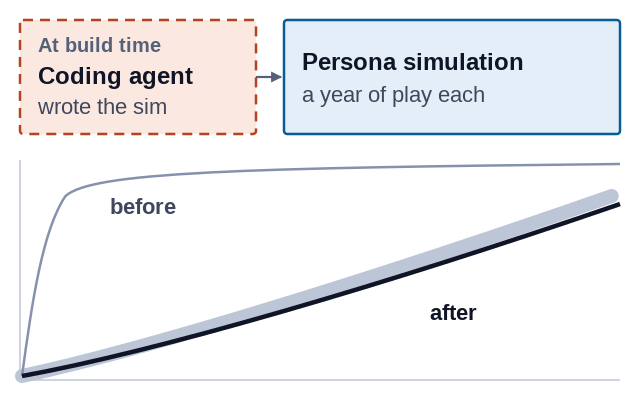
Thai language podcast
A short Thai-language news episode built from public news feeds, for a learner above beginner level. The first episode is on its RSS feed.
A private podcast for my own Thai practice. A script pulls the day’s business stories from public Thai news feeds. A model rewrites a handful of them in plain Thai, and a Thai text-to-speech voice reads the script. Each episode comes with a transcript and a transliteration, so I can read along.
The feed is a plain RSS file that any podcast app can subscribe to. The next version adds two hosts and a speaking-practice mode.
- Fetch the day’s news (code)
- Rewrite in plain Thai (model)
- Thai voice reads it (model)
- Publish to the feed (code)
Spotify playlist organizer
Scripts that moved an old iTunes library to Spotify, merged every playlist into one deduplicated master list, and sorted it by decade, genre and country.
Two one-off tools for my own music library. The first rebuilt my iTunes playlists on Spotify and recovered the tracks the first pass missed. The second merged every playlist into one deduplicated master list, then sorted it into playlists by decade, genre and country.
In development mode, the Spotify API refuses to create playlists, so the scripts fill playlists I create by hand. Reads share a small daily budget, so every step caches its results, stops cleanly when rate-limited and resumes the next day. Album dates are often wrong: a greatest-hits album carries the compilation’s release year, which can be years after the song came out. When an album looks like a reissue, the decade comes from the artist’s catalog. Most of the work went into these limits, and the documentation mentions few of them.
Genres needed a two-level mapping. Artists carry dozens of micro-genres. These roll up into about a dozen parent genres. When Spotify has no genre, a second public music database fills in.
- Read the iTunes library (code)
- Match tracks on Spotify (code)
- Merge and dedupe (code)
- Sort by decade, genre, country (code)